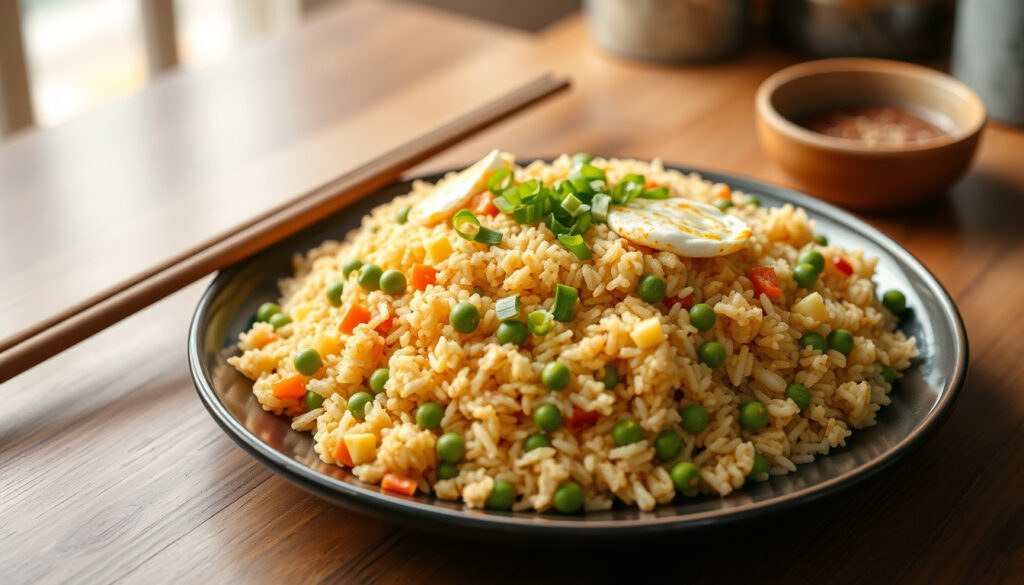
Egg Fried Rice Recipe: Best Takeaway Style at Home
There’s a reason takeaway egg fried rice hits different — each grain stays perfectly separate, coated in savory richness, with just a hint of wok smokiness. Most home versions fall flat because of one simple mistake: using hot, fresh rice instead of the cold stuff sitting in yesterday’s pot. This recipe fixes that, plus four other techniques trained chefs swear by to get that restaurant-quality texture and flavor in under 20 minutes.
Servings: 4 · Prep Time: 10 minutes · Cook Time: 10 minutes · Calories per serving: 400 kcal · Key ingredient: Day-old rice
Quick snapshot
- Day-old rice prevents mushiness (Easy Peasy Foodie)
- High wok heat develops wok hei flavor (Red House Spice)
- Minimal ingredients, one-pan cook (Red House Spice)
- Ready in 10 minutes total for 3 servings (Red House Spice)
- Chef technique: fry rice first, then coat with beaten eggs (Michelin Guide)
- Neutral oil required, not olive oil (Red House Spice)
- Yangzhou fried rice originated in Yangzhou city (Wikipedia)
- Popularized by scholar Yi Bingshou during the Qing Dynasty (The Food Dictator)
The table below consolidates essential parameters for replicating takeaway-quality egg fried rice at home.
| Detail | Value |
|---|---|
| Core ingredients | Cooked rice, eggs, oil, soy sauce |
| Preferred rice type | Day-old or chilled |
| Cookware | Wok or large frying pan |
| Common oil | Vegetable or neutral |
| Rice-to-water ratio (restaurant standard) | 1kg:850g |
| Cost for 4 portions | £2.50 |
How to make the best egg fried rice?
The secret to really good egg fried rice starts before you even turn on the stove. Professional chefs and home cooks alike agree on one non-negotiable: cold, dry rice is the foundation of every successful batch.
Ingredients for best results
- 350g cold pre-cooked rice (long grain or basmati works well)
- 2 large eggs, beaten with a pinch of salt
- 2 tablespoons vegetable or neutral oil
- 1 tablespoon light soy sauce
- ½ tablespoon dark soy sauce (for color)
- 1 teaspoon sesame oil
- 2-3 scallions, finely sliced
- 2 cloves garlic, minced
- White pepper to taste
- MSG (optional, but adds authentic umami)
Traditional recipes stick to simple seasonings — salt, pepper, soy sauce, sesame oil — letting the rice and eggs shine without distraction.
Step-by-step cooking method
- Ensure your rice is cold and dry. If using fresh rice, spread it on a tray and refrigerate for at least 30 minutes to remove excess moisture.
- Heat your wok or large frying pan over high heat until smoking. Add oil and swirl to coat.
- Add minced garlic and stir for 10 seconds until fragrant.
- Add cold rice and stir-fry for 2 minutes, breaking up any clumps, ensuring each grain heats through and coats in oil.
- Push rice to one side, creating a well. Add beaten eggs and let them sit undisturbed for 45 seconds before gently folding into the rice.
- Add soy sauces, sesame oil, and white pepper. Toss everything together until evenly coated.
- Finish with sliced scallions and serve immediately.
High heat for a short time keeps rice grains fluffy and distinct. A restaurant chef at the Michelin Guide confirms that frying rice in oil first, then adding beaten eggs, coats each grain for that signature golden appearance.
What are common mistakes when making egg fried rice?
Even experienced home cooks stumble on these pitfalls. Knowing them in advance saves you a disappointing dinner and a greasy wok scrub.
Overcrowding the wok
When too much rice fills the pan, temperatures drop and the grains steam instead of fry. They clump together, becoming mushy rather than fluffy. Work in batches if needed — a crowded wok is the single most common reason takeaway-style results elude home cooks.
Using fresh rice
Freshly cooked rice contains too much moisture and the grains are still swelling. They break apart easily and stick together into a gummy mess. Easy Peasy Foodie puts it plainly: “The secret to really good egg fried rice is to use cold rice. It goes all wrong if you use hot rice!”
If you only have fresh rice, spread it on a baking sheet and chill in the refrigerator for 30-60 minutes. Some cooks even freeze it for 15 minutes to speed the process. The goal is dry, cool, separated grains ready to absorb high heat.
How to make Chinese takeaway egg fried rice?
Chinese takeaway versions follow a specific sequence that differs slightly from traditional home cooking. Getting the egg-rice order right transforms your results.
Authentic seasoning approach
Takeaway recipes typically use a combination of light and dark soy sauce. Light soy provides salinity, while dark soy adds color and a subtle molasses-like sweetness. Sesame oil goes in at the end, never during cooking, to preserve its aromatic quality.
Takeaway technique tips
- Wok temperature matters more than wok material. A carbon steel or cast iron wok over a high-BTU burner achieves the best results, but a heavy-bottomed skillet works on home stoves.
- Neutral oils like vegetable, peanut, or grapeseed stand up to high heat. Olive oil smokes and imparts wrong flavors.
- Add spring onions and raw lettuce last for crunch — a technique Michelin Guide chefs recommend for texture contrast.
- Some takeaway recipes include MSG for authenticity. It’s entirely optional but provides that fifth taste dimension.
What is the secret to the best fried rice?
Beyond ingredients and technique, professional chefs reveal a few less obvious secrets that separate their fried rice from the everyday version.
Chef secrets from Made With Lau
A recipe taught by a 2x James Beard Award Winning Chinese Chef emphasizes gentle handling. The eggs receive 20-30 seconds of gentle stirring before the rice joins them. This allows the eggs to set slightly while remaining soft and custardy within the rice matrix.
Temperature control
The rice-to-water ratio matters long before cooking begins. Michelin Guide standards call for 1kg aged rice to 850g water — slightly less water than standard cooking produces drier, more separated grains. This “aged rice” technique is how restaurant kitchens prep their starch base days in advance.
At our restaurant, we first fry the rice in oil then add beaten eggs so that each grain of rice is coated with egg and takes on a golden yellow hue so that it resembles an auspicious ‘mound of gold’.
— Michelin Guide restaurant chef
How to make a simple egg fried rice?
When time is tight and the pantry is sparse, this stripped-back version delivers without compromise. Sometimes the simplest approach tastes best.
Minimal ingredients list
- 2 cups day-old rice
- 2 eggs
- 1 tablespoon oil
- 1 tablespoon soy sauce
- Salt and pepper
Quick one-pan method
- Whisk eggs with a pinch of salt and pepper.
- Heat oil in a large pan over medium-high heat.
- Pour in eggs and let them set for 30 seconds before scrambling gently.
- Add cold rice, breaking up clumps and stirring until heated through, about 2-3 minutes.
- Drizzle soy sauce around the pan edges, toss, and serve.
Simple versions sacrifice some complexity for speed, but they prove an important point: great fried rice doesn’t require a fully stocked pantry. The technique — not the ingredient count — drives the result.
Regional variations worth knowing
Beyond the basic egg fried rice, Chinese regional cuisines have developed distinct versions with unique ingredients and techniques.
- Yangzhou fried rice: Originates from Yangzhou city and is considered the benchmark for Chinese fried rice. It uses multiple proteins (typically char siu, shrimp, pork) and coats each grain in egg yolk for a golden appearance. Scholar Yi Bingshou is credited with popularizing this style during his tenure as prefect of Yangzhou (1754-1815).
- Sichuan fried rice: Brings heat with doubanjiang chili sauce, garlic, green and red onion. The spice paste transforms the mild base into a fiery dish.
- Fujian (Hokkien) fried rice: A wetter style where a cornstarch-thickened seafood sauce pours over fried rice, contrasting with the dry wok-fried approach.
- Singapore Cantonese: Includes prawns, char siew, eggs, spring onions, and raw lettuce stirred in at the end for crunch.
Generally, fried rice is well-loved by young and old so there are inevitably many iterations on this dish throughout China.
— Chef Foo, Group Executive Chef at Crystal Jade (via The Food Dictator)
What this technique handles well
- Fluffy, separated grains when using day-old rice
- Authentic wok hei flavor with proper heat
- Customizable protein and vegetable additions
- Budget-friendly: £2.50 for four portions
Where results vary
- Fresh rice produces mushy texture
- Low heat causes steaming instead of frying
- Exact calorie counts depend on oil and sauce quantities
- Wok-only technique difficult on home stoves
Related reading: Thai Green Curry Recipe
youtube.com, youtube.com, greedy-panda.com, youtube.com, youtube.com
Home cooks chasing takeaway-style egg fried rice can master perfect non-sticky results using day-old rice and high wok heat for fluffy grains.
Frequently asked questions
Can I use fresh rice for egg fried rice?
Fresh rice leads to mushy, clumping results. The grains are too moist and soft. For best results, use rice that’s been refrigerated overnight or spread fresh rice on a tray and chill for 30-60 minutes before cooking.
What oil is best for egg fried rice?
Neutral oils work best: vegetable, peanut, or grapeseed oil tolerate high heat without smoking. Lard or peanut oil provides authentic restaurant flavor. Avoid olive oil — it smokes at frying temperatures and imparts the wrong taste.
How do I store leftover egg fried rice?
Cool completely and transfer to an airtight container. Refrigerate for up to 3 days or freeze for up to 1 month. Reheat in a hot wok or skillet with a splash of oil to restore texture.
Is egg fried rice gluten-free?
Traditional egg fried rice uses soy sauce, which typically contains gluten. For a gluten-free version, substitute tamari or coconut aminos. Always check labels since soy sauce brands vary.
What vegetables go in egg fried rice?
Common additions include frozen peas and carrots, diced bell peppers, bean sprouts, corn, and mushrooms. Add vegetables that cook quickly and retain some crunch. Spring onions go in last for fresh brightness.
Can egg fried rice be made vegetarian?
Yes — the basic recipe with rice, eggs, and seasonings is already vegetarian. Swap soy sauce for gluten-free tamari, and add extra vegetables like edamame, tofu cubes, or mushrooms for variety.
How to reheat egg fried rice?
Use a hot wok or skillet over medium-high heat. Add a splash of oil and break up the rice, stirring until heated through and slightly crispy at the edges, about 3-4 minutes. Microwaving works but yields softer results.
For home cooks, the choice is clear: keep day-old rice in your fridge and master the high-heat stir-fry sequence. Those two moves alone bridge the gap between homemade and takeaway — no restaurant equipment required.
More related posts
 Saturn Devouring His Son: Meaning and History
 Shein Canada En Français – Language Support and Switching Guide
 Canadian Immigration Processing Delay – 2025 Times & Backlogs
 What Do Bed Bug Bites Look Like? Identification and Relief
 Milos Raonic Retires: Career, Injuries and Legacy
 Kendra Scott Biography: Net Worth, Marriages & Faith
 Tire Comparison: How to Compare Sizes, Performance, and Brands
 Diablo 4 Release Date: PS5, Xbox, Base & Lord of Hatred
