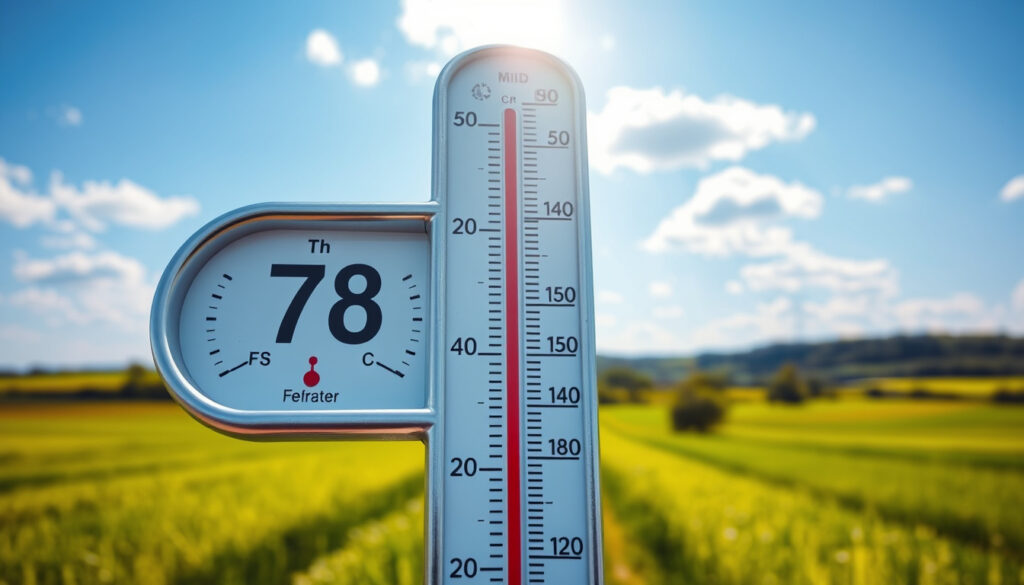
78 Fahrenheit to Celsius: 25.56°C + Comfort Guide
78°F sits at the crossroads of energy savings and summer comfort—a temperature the U.S. Department of Energy endorses as the optimal cooling setpoint, yet one that many Americans find warmer than they expect. Converting 78°F to Celsius gives 25.56°C, placing it at the upper boundary of typical room comfort and well below the WHO’s health ceiling.
78°F in Celsius: 25.56°C · Conversion Formula: (°F − 32) × 5/9 · Comfort Range (Room): 20–25°C (68–77°F) · Summer Thermostat Ideal: 24–26°C · Boiling Point Celsius: 100°C
Quick snapshot
- 78°F = 25.5556°C exactly (Trane / U.S. DOE source)
- U.S. DOE recommends 78°F for summer cooling efficiency (Trane / U.S. DOE source)
- Each degree above 72°F saves up to 3% on cooling costs (Trane / U.S. DOE source)
- Exact publication date for the U.S. DOE 78°F recommendation
- Quantitative humidity interaction data at 78°F
- Long-term health impacts of sustained 78°F exposure
- 2017: Bodek Inc. published energy savings data on 78°F
- Ongoing: Wikipedia compiles global room temperature studies
- Pre-2023: U.S. DOE established 78°F summer standard
- Smart thermostats may auto-adjust to 78°F as energy-saving default
- Rising energy costs make the 78°F sweet spot increasingly relevant
- Regional climate adaptation may shift comfort expectations
| Label | Value |
|---|---|
| Exact Conversion | 78°F = 25.5556°C |
| Rounded Value | 25.6°C |
| F to C Formula | (F − 32) × 5/9 |
| Room Comfort (F) | 68–78°F |
| Summer Setpoint | 78°F (25.6°C) |
What temperature is 78 F in Celsius?
78°F equals 25.56°C. That’s the straightforward answer, and it lands squarely in the mild summer range.
Conversion formula
The formula to convert any Fahrenheit temperature to Celsius is: (°F − 32) × 5/9. For 78°F, the math breaks down like this: subtract 32 to get 46, multiply by 5 to get 230, then divide by 9 to land on approximately 25.556°C.
The best indoor temperature for your home during the summer months is 78 degrees, according to the U.S. Department of Energy.
— Trane HVAC resource blog
Step-by-step calculation
- Step 1: 78 − 32 = 46
- Step 2: 46 × 5 = 230
- Step 3: 230 ÷ 9 = 25.556
- Result: 78°F = 25.556°C
Precise value from charts
Standard conversion tables confirm 78°F is precisely 25.56°C (rounded to two decimal places). Weather charts from NASA align to this same value. For quick reference, 78°F sits just above the middle of the typical room comfort range — warmer than most people prefer indoors, but well below body temperature.
Is 78 Fahrenheit cold or hot?
For most people in the United States, 78°F feels warm — not sweltering, but definitely on the warm side for an indoor space. Context matters enormously.
Perception by season
In summer, 78°F registers as warm but manageable — especially when you’re stepping in from 95°F outdoors. In winter, the same temperature feels stifling because your body has acclimatized to cooler conditions. A person from Minnesota may call 78°F hot in May but comfortable by late July. Someone from Nigeria, where 78°F falls in the “comfortably cool” range, would find it mild. Regional adaptation genuinely shifts the hot/cold judgment.
Comparison to body temp
Average human body temperature sits around 98.6°F (37°C). At 78°F, you’re roughly 20°F below body temperature, which means your body doesn’t have to work hard to dissipate heat — the environment feels pleasant rather than cold. By contrast, 50°F feels noticeably cool because the gap widens to nearly 50°F.
Heat index factors
Heat index combines temperature with humidity to express how hot it actually feels. At 78°F with 50% humidity, the feels-like temperature stays near 78°F. Bump the humidity to 70%, and 78°F can feel closer to 81°F. High humidity makes your body’s natural cooling (sweating) less effective, pushing the perceived temperature higher than the actual reading.
Set your cooling thermostat as high as you can that comfort allows. The higher the setting, the more energy you will save.
78°F feels different depending on where you live, what season it is, and whether humidity is working against you. There’s no universal “hot or cold” verdict — only contextual answers.
Is 78 degrees good for a house?
Yes — for summer cooling specifically, 78°F is widely endorsed as a smart balance between comfort and energy conservation.
Thermostat recommendations
Both Carrier and Trane (major HVAC manufacturers) recommend 78°F as an optimal summer cooling setpoint. The U.S. Department of Energy backs this same figure as the ideal balance point for energy efficiency during warmer months. At this setting, your cooling system works less hard than it would at 72°F, which translates directly to lower utility bills.
Try setting your air conditioning system at 78 degrees Fahrenheit for a good mix of comfort and energy efficiency.
Energy savings tips
Each degree above 78°F you raise the thermostat saves 6–8% on your energy bill per degree, according to HVAC data from Bodek Inc. Raising the thermostat 7–10°F when you’re away from home can cut cooling costs by approximately 10%. That adds up over a hot summer. The trade-off is comfort — push it too far above 78°F and the space becomes stuffy rather than merely warm.
Humidity impact
Humidity complicates the picture. A dry 80°F feels far more tolerable than a humid 78°F. If your home holds moisture, running the AC slightly cooler or adding a dehumidifier can make 78°F feel substantially more comfortable without dramatically raising energy costs. The feels-like temperature matters as much as the thermostat setting.
The WHO sets 89.6°F as a daytime health ceiling for indoor spaces. Above that threshold, the body struggles to cool itself effectively, raising risks for elderly residents, infants, and anyone with cardiovascular conditions. Most people find anything above 80°F indoors uncomfortable without active cooling.
What is a comfortable room temperature?
Most sources cite 20–25°C (68–77°F) as the general comfort band for occupied indoor spaces, though the sweet spot shifts by activity level, season, and who you’re asking.
Celsius vs Fahrenheit ranges
In Celsius terms, Europeans often target 20–23°C for living spaces, while bedroom temperatures run 2–3°C cooler at 16–19°C. In the United States, the Fahrenheit equivalent (68–74°F) dominates thermostat guidance. The Swiss Federal Office of Public Health recommends 20–21°C for living rooms and 18°C for bedrooms during heating season — figures that track closely with the Energy Saving Trust’s UK recommendation of 18–20°C as the lowest comfortable temperature.
By activity level
Light activity (reading, watching TV) sits comfortably in the standard 20–24°C range. Exercise or heavy housework drops that comfortable threshold by several degrees because your body generates its own heat. The Sleep Foundation recommends bedrooms at 65–68°F (18–20°C) for adults — notably cooler than daytime occupied spaces.
Seasonal adjustments
Winter heating typically targets 68°F as the energy-efficient baseline, while summer cooling pushes toward 72–78°F depending on tolerance. The gap between heating and cooling seasons means your thermostat dial travels roughly 10°F over the year. For year-round comfort without excessive energy draw, the Swiss guidance on separate living-room and bedroom targets — cooler spaces for sleep, warmer for activity — offers a practical framework.
The government says it’s best to set your thermostat to 78 degrees.
78°F (25.6°C) sits near the top of the general room comfort range. It’s warm enough for summer cooling efficiency but mild enough that most healthy adults won’t feel overheated. The WHO sets 89.6°F as a daytime health ceiling — 78°F is well below that threshold.
Related Fahrenheit to Celsius Conversions
Five nearby conversions help put 78°F in context and offer quick reference points for common thermostat settings.
| Fahrenheit | Celsius | Context |
|---|---|---|
| 72°F | 22.2°C | Cool side of room comfort |
| 74°F | 23.3°C | Low end of summer setpoint |
| 75°F | 23.9°C | Upper comfort range |
| 76°F | 24.4°C | Just below 78°F |
| 85°F | 29.4°C | Warm outdoor summer day |
| 90°F | 32.2°C | Hot summer peak |
How to convert Fahrenheit to Celsius
The step-by-step method works for any Fahrenheit value you encounter. Memorizing the formula means you’ll never need a converter app again.
- Subtract 32 from the Fahrenheit temperature. This adjusts for the offset between the two scales (water freezes at 32°F but 0°C).
- Multiply the result by 5. This scales the interval to match Celsius degrees.
- Divide by 9. This completes the conversion, giving you the Celsius equivalent.
- Round to one or two decimal places for practical use. For 78°F: (78 − 32) × 5/9 = 25.56°C.
A quick mental shortcut: 0°C equals 32°F, so the scales align roughly every 180°F/100°C or 1.8°F per 1°C. That means for every 1.8°F above 32, you gain 1°C. So 78°F minus 32 equals 46 “steps” of 1.8°F; 46 ÷ 1.8 ≈ 25.6°C — close enough for estimation.
Related reading: 18 Inches in CM – Exact 45.72 cm Conversion · 1/3 Cup in Tbsp – 5 Tbsp + 1 Tsp Exact Conversion
en.wikipedia.org, stadlerform.com, britishgas.co.uk, reolink.com, magicwindow.ca, leejacksonac.co.uk, idealheating.ca
The 78°F comfort range of 25.56°C finds detailed parallels in the 78°F to Celsius guide, which explores thermostat tips and energy savings.
Frequently asked questions
How do you convert Fahrenheit to Celsius?
Subtract 32 from the Fahrenheit value, multiply by 5, then divide by 9. For 78°F: (78 − 32) × 5/9 = 25.56°C. Rounding to two decimal places gives you 25.56°C for practical use.
What is 25°C in Fahrenheit?
25°C equals 77°F. Using the reverse formula: (25 × 9/5) + 32 = 77°F. This puts 25°C squarely in the comfortable summer range — just below 78°F.
Is 70°F comfortable outdoors?
For most people, 70°F (21°C) feels pleasantly mild — the lower end of “room temperature” comfort. It’s cool enough for light activity without a jacket but warm enough for shorts on a sunny day. Personal preference and wind exposure shift the perception.
What is too hot for indoor temperature?
The WHO sets 89.6°F as a daytime health ceiling for indoor spaces. Above that threshold, the body struggles to cool itself effectively, raising risks for elderly residents, infants, and anyone with cardiovascular conditions. Most people find anything above 80°F indoors uncomfortable without active cooling.
Does humidity affect 78°F comfort?
Yes. High humidity makes 78°F feel substantially warmer because sweat evaporates more slowly. A dry 80°F often feels more comfortable than a humid 78°F. If your home’s humidity runs above 50–60%, a dehumidifier or slightly cooler thermostat setting helps compensate.
Best winter thermostat setting?
Carrier recommends 68°F as the energy-efficient heating baseline for most homes. For sleeping, the UK Sleep Charity suggests 16–18°C (61–64°F) — notably cooler than daytime occupied spaces. Raising the thermostat when you’re away by 7–10°F can save roughly 10% on heating costs.
How accurate are online converters?
Most online converters use the exact same formula — (°F − 32) × 5/9 — and produce accurate results within rounding. The variation comes only in decimal places shown: one decimal (25.6°C) versus two decimals (25.56°C). Both are correct for practical purposes.
What bedroom temperature is ideal for sleep?
The Sleep Foundation recommends 65–68°F (18–20°C) for adult bedrooms. For infants, 69°F is the suggested target. These cooler nighttime temperatures support the body’s natural temperature drop during sleep, improving sleep quality across multiple studies.
What is 72 Fahrenheit to Celsius?
72°F converts to 22.2°C. This temperature sits on the cool side of typical room comfort — many people find it slightly cool for summer living spaces but acceptable when active or when outdoor temperatures are higher.
More related posts
 Train from Vancouver to Seattle: Schedules, Prices & Tickets
 La Bettola di Terroni – Full Guide to Toronto Location
 Tom Ellis: Biography, Family, Net Worth, Recent Projects
 Canadian Immigration Processing Delay – 2025 Times & Backlogs
 Best Movies to Watch: Top 10 Now & All-Time Classics
 Now You See Me 2: Ca t Change , Streaming, and Sequel New
 Bleu de Chanel Parfum: Review, Notes & Buy 2025 Guide
 Sault Ste Marie Weather Winter Storm: Updates & Forecast
