How to Play Checkers – Rules, Setup and Strategies
Checkers remains one of the most widely played strategy games worldwide, with origins tracing back thousands of years to ancient board games.
The modern version, standardized in the 19th century, offers an elegant balance of simple rules and strategic depth.
It has become a staple in households, schools, and competitive tournaments across North America.
This comprehensive guide explains the standard rules of American checkers, also known as English draughts. It covers everything from initial board configuration to advanced jumping sequences and king promotion.
Whether you are learning for the first time or refreshing your knowledge, these instructions provide the foundational framework for two-player matches using the 8×8 board format most common in the United States and Canada.
Unlike chess, where each piece type moves differently, checkers utilizes uniform pieces with movement restrictions that change only upon promotion.
The objective is straightforward: capture all opponent pieces or block them completely.
Achieving this requires understanding mandatory jumping rules and diagonal movement constraints.
How Do You Set Up a Checkers Board?
- Only the 32 dark squares are used for piece placement and movement
- Black pieces (darker color) always move first in standard rules
- All 12 pieces occupy the three rows closest to each player
- Uncrowned men may only move diagonally forward until promoted
- Jumping over opponent pieces is mandatory when available
- Reaching the opposite back row transforms a piece into a king
- Kings gain the ability to move backward diagonally
| Rule | Description |
|---|---|
| Board Configuration | 12 pieces placed on dark squares in first three rows per side |
| Starting Player | Dark-colored pieces (typically black) move first |
| Movement Direction | Diagonal only, forward for uncrowned pieces |
| Capture Method | Jumping over adjacent opponent pieces |
| Promotion | Piece crowned at farthest row (king’s row) |
| Win Conditions | Complete capture or total blocking of opponent |
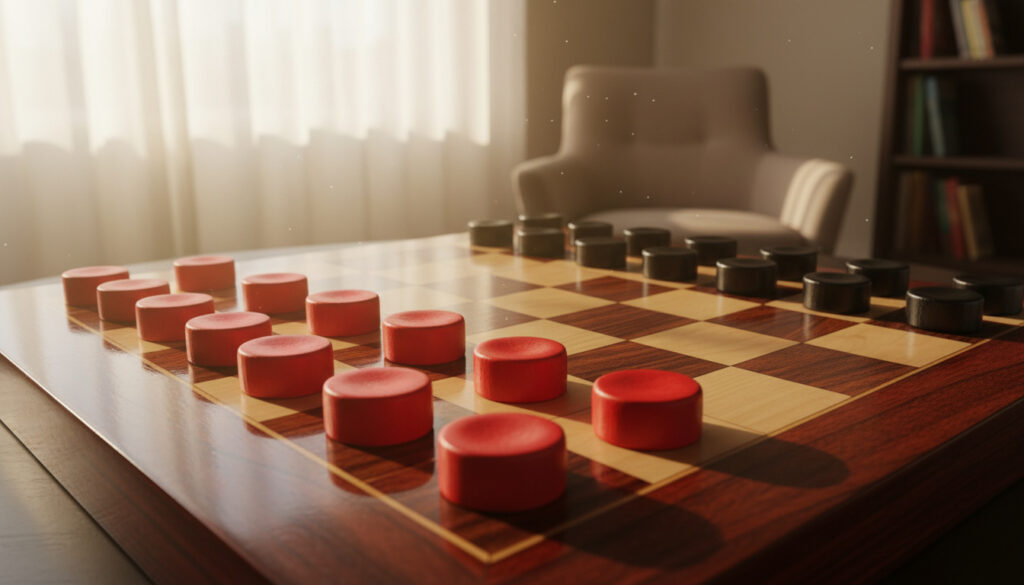
The game requires an 8×8 board with 64 alternating squares, though play is restricted to the 32 dark squares exclusively. Each player commands twelve pieces placed on the dark squares of the first three rows facing them, leaving the two center rows initially empty.
Competitors sit opposite each other, with players positioning themselves across the board to begin play. The player using the darker-colored pieces (typically black) makes the opening move. If a series of games is played, the player who lost the previous match traditionally moves first in the subsequent round, or players may agree on another method.
What Are the Basic Movement Rules?
Each turn consists of moving a single piece diagonally along the dark squares. Uncrowned men, often called simply “pieces” or “men,” may advance only toward the opponent’s side, never retreating toward their own starting position.
Movement is restricted to unoccupied squares immediately adjacent in the diagonal direction. A piece can only move into an unoccupied square, and all activity occurs exclusively on the dark squares, leaving the 32 light-colored squares unused throughout the game.
A piece cannot move backward until it has been promoted to king status. No piece may move horizontally or vertically, and only one piece may be moved per turn.
How Do You Jump and Capture Pieces?
Capturing occurs by jumping over an opponent’s piece when the square immediately beyond it lies empty. The jumped piece is removed from the board and considered captured.
Is Capturing Mandatory?
Yes. If you have the option to jump, you must make the jump in most official rules. When multiple jumping opportunities exist, the player may select which sequence to execute, but cannot decline to capture entirely.
Can You Execute Multiple Jumps?
Multiple captures can occur in a single turn when a piece makes successive jumps, potentially changing direction or “zigzagging” across the board. This can result in capturing several opponent pieces in a single move.
Can You Jump Backwards?
Uncrowned men cannot jump backward. Only king pieces possess this ability. Furthermore, jumping your own pieces is never permitted under any circumstances; only opponent pieces are valid targets for capture.
What Happens After a Jump into the King Row?
Men that jump into position to be kinged are not treated as kings until the next turn, leaving them vulnerable to immediate counter-capture.
How Do King Pieces Work?
A piece becomes a king only when it reaches the farthest row forward, marked by placing an additional piece on top to indicate its new status.
How Do You Make a King?
When any uncrowned man reaches the opponent’s back row (the king’s row or crown head), it receives promotion immediately. This is marked by placing an additional piece on top of the original piece, or “crowning” it.
Once promoted, kings can move both forward and backward diagonally, unlike uncrowned men that are restricted to forward movement only. For more information on how to play checkers, you can check out this auto clicker anleitung.
How Do Kings Move?
Kings enjoy significantly expanded mobility compared to regular pieces. They may advance or retreat along diagonal lines, capturing in either direction. In international checkers, kings can move any amount of squares at a time, whereas American checkers kings generally move one square at a time like regular pieces, but with the added benefit of backward movement.
Men that jump into position to be kinged are not treated as kings until the next turn, leaving them vulnerable to immediate counter-capture if the opponent can respond.
How Do You Win a Game of Checkers?
Victory occurs through one of two definitive conditions. A player wins immediately when they have captured all twelve of the opponent’s pieces, leaving no remaining units on the board.
Alternatively, the opponent has no legal moves remaining due to pieces being blocked or captured. This typically happens when all remaining pieces are blocked by the edge of the board or surrounded such that no diagonal movement is possible, even if pieces remain uncaptured.
How Does a Checkers Game Progress Step by Step?
- Initial Setup: Place twelve pieces on the dark squares of the first three rows facing each player, leaving the center rows empty.
- Opening Move: The player controlling the darker-colored pieces (black) moves first, advancing any piece diagonally forward one square.
- Alternating Play: Players take turns moving single pieces diagonally forward, with mandatory jumps when available.
- Capturing Sequences: Execute jumps over adjacent opponent pieces, removing them from the board and continuing with multiple jumps if possible.
- Promotion Phase: Advance pieces to the opponent’s back row to achieve king status, gaining backward movement capabilities.
- Endgame Resolution: Continue until one player captures all opponent pieces or blocks all remaining legal moves.
Which Rules Are Universal and Which Depend by Region?
| Established: American Checkers | Variable: International Draughts |
|---|---|
| 8×8 board with 12 pieces per player | 10×10 board with 20 pieces per player |
| Men move and jump forward only | Men can jump both forward and backward |
| Kings move one square diagonally (forward/backward) | Kings are “flying kings” moving any distance |
| Mandatory capture rules enforced | Capture rules vary by regional federation |
What Is the Historical and Strategic Context of Checkers?
The diagonal movement pattern unique to checkers derives from ancient games like Alquerque, which traveled from the Middle East to Europe during the medieval period. The 8×8 chessboard was adopted in the 12th century, creating the modern framework. This geometric constraint forces players to think several moves ahead, as pieces cannot directly advance without navigating the diagonal grid.
Center control provides significant tactical advantages. The center of the board provides tactical advantage, similar to chess strategy, with pieces occupying the middle rows enjoying maximum flexibility. Strategic Tips for Beginners emphasize moving pieces in pairs rather than isolation, as solitary checkers present easy capture targets. The game rewards aggressive positioning over passive defense, requiring players to balance protection of their own pieces with advancement toward promotion.
What Do Official Sources Say About Checkers Rules?
“If you have the option to jump, you must make the jump. When multiple jumping opportunities are available, you can choose which one to take.”
“A piece becomes a king when it reaches the farthest row forward. This is marked by placing an additional piece on top of the original piece.”
How Can Beginners Start Playing Immediately?
New players should begin by practicing the Board Setup until piece placement becomes automatic, then focus on recognizing mandatory jump opportunities. Playing against computer opponents or using online checkers platforms allows repetition of basic scenarios without the pressure of competitive matches. As familiarity grows, studying opening formations and endgame techniques from official rulebooks provides the foundation for tournament play.
Frequently Asked Questions
What is the difference between American checkers and international draughts?
American checkers uses an 8×8 board where men jump only forward, while international draughts uses a 10×10 board where men can jump backward and kings move any number of squares.
Can you jump backwards in checkers?
Uncrowned men cannot jump backward in American checkers; only king pieces can move and capture backward. However, international draughts allows men to jump in both directions.
Can you jump your own pieces in checkers?
No. Jumping is exclusively for capturing opponent pieces. You cannot jump over your own pieces under any circumstances.
What happens if you don’t want to jump?
In official American checkers rules, jumping is mandatory when available. If you have a legal jump, you must take it; declining is not permitted.
How many squares can a king move?
In American checkers, kings move one square at a time like regular pieces but can move forward or backward. In international draughts, kings are “flying kings” that can move any number of empty squares.
Can you move multiple pieces in one turn?
No. Only one piece may be moved per turn, except when a single piece makes multiple jumps in a capturing sequence, which counts as one turn.
Who goes first in checkers?
The player with the darker colored pieces, typically black, moves first. If playing multiple games, the player who lost the previous game often goes first in the next round.
More related posts
 Back to the Future: Release Dates, Quotes & Why No Part 4
 Croix Bleue Assurance Voyage – $5M Coverage Guide 2025
 Scrap Yard Near Me – Locations, Prices and Selling Guide
 Inter Miami vs New York City FC Lineups: Starting XIs
 Apple Watch Ultra 2: Specs, Price, Features, and Comparison (2025)
 Population of Calgary 2025: Growth, Wealth & Demographics
 Warren Buffett: Biography, Net Worth, and Investment Strategy
 Azelaic Acid The Ordinary – Benefits, Usage and Reviews
